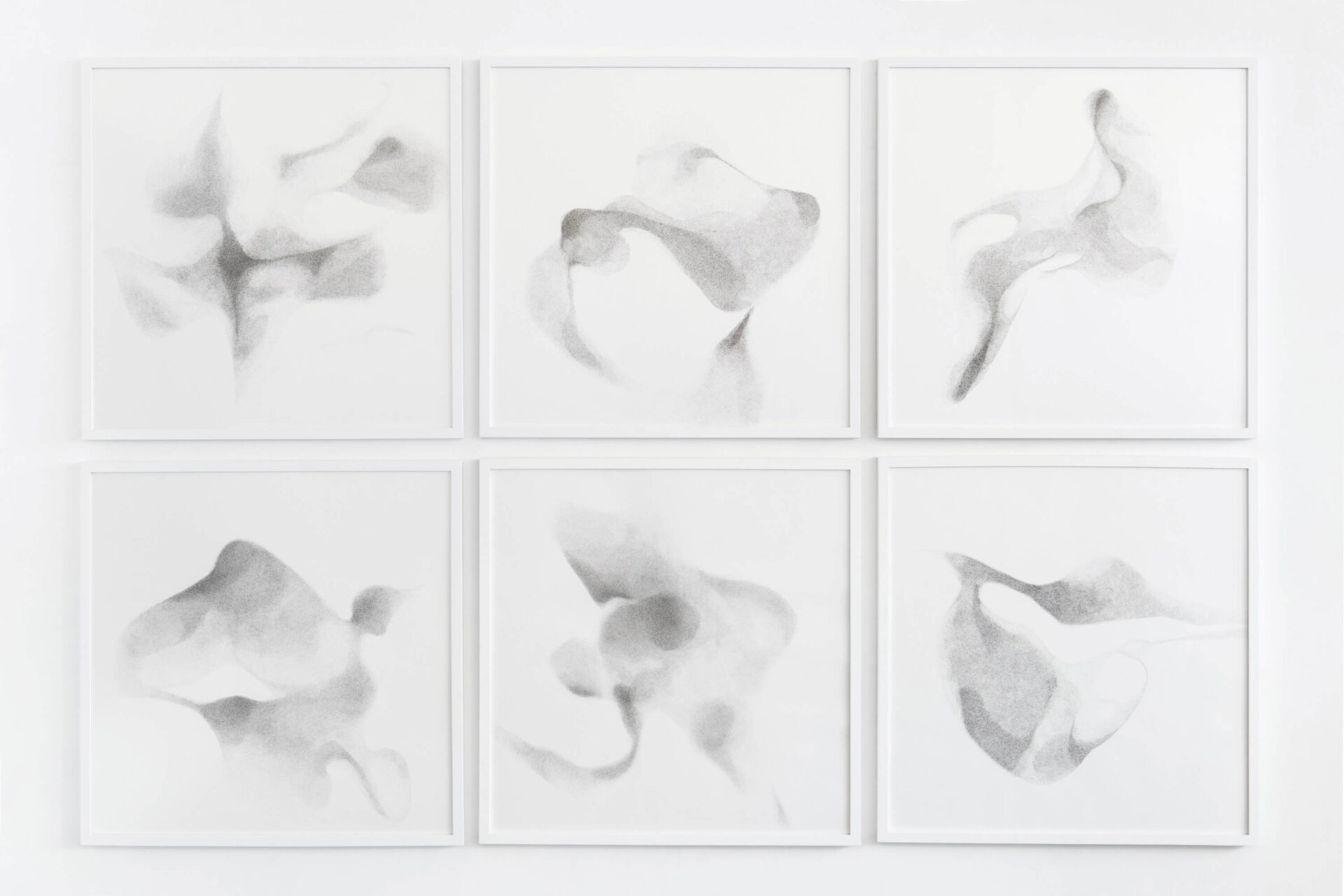
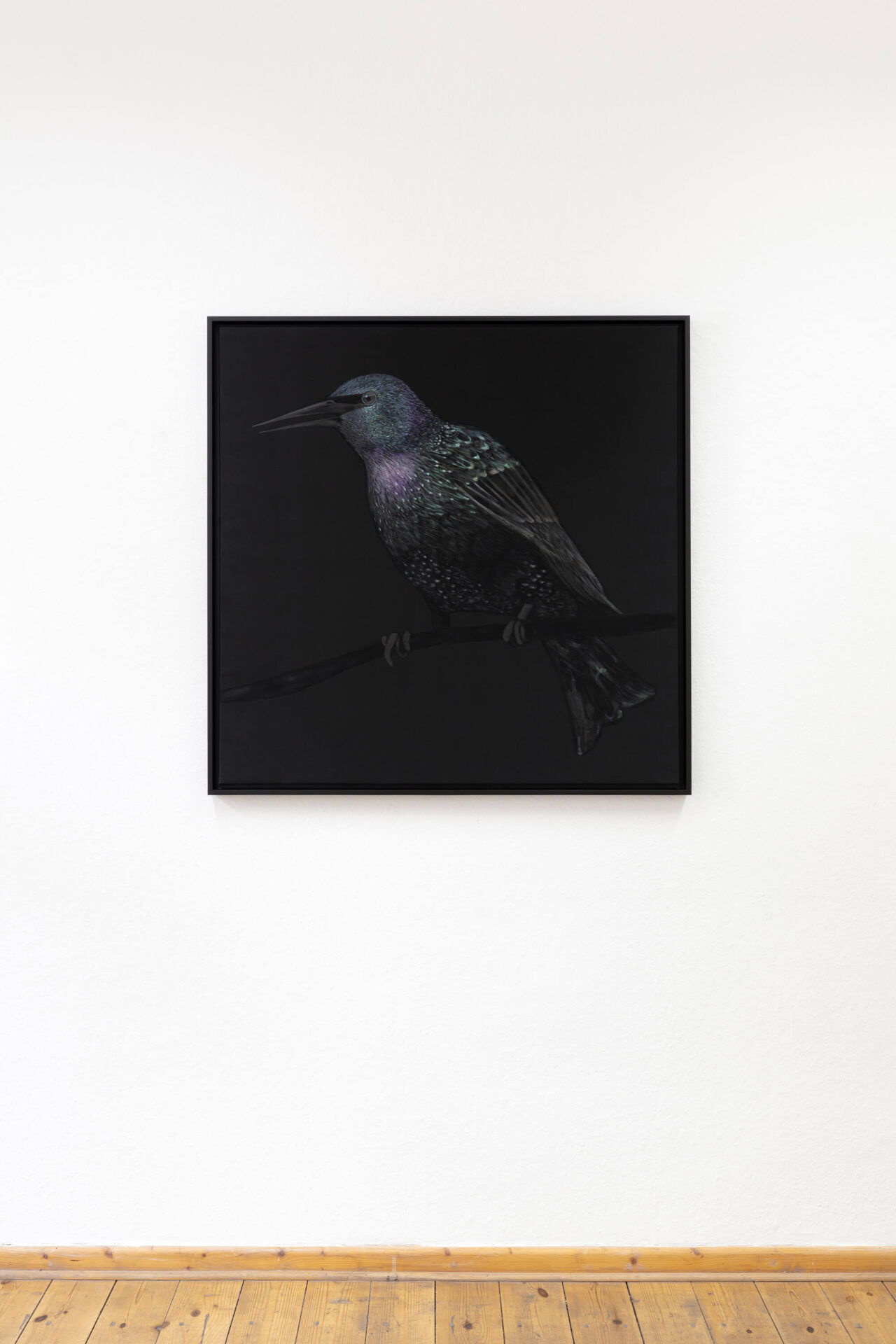
Uncertainty in consensus, 2025
​​​
Museo Patio Herreriano,
Valladolid, ES, 2025
​
Photo credits: Jeremy Knowles, Víctor Hugo Martín Caballero
​
​

A message written on the subway tile wall could have been seen for seconds, hours or a couple of days.
When I arrived, it had already been cleaned.
I was never able to read it.
Now, I can only try to decipher the message from the remains of the writing that can be seen between the tiles, which could not be erased.
It is a speculative process on a wall.
Other walls in the city have also undergone speculative processes.


At night, streetlights, wind and trees team up to change the colour of building facades.
The streetlights screen their orange light on white and grey, creating an infinite number of ochre and pink tones.
The trees project their shadow, which is not grey, but forms a whole pantone of blues and violets.
The wind makes it possible for all these colours to change position and jump from one wall to another.
Only black remains static, unchanging and seems to have more power than the wind, the light and the trees.
Black is not in the visible spectrum of light.
Black is the only colour that can exist if light ceased to exist.
The night could be the day, if we compare it with the darkness of black.


Someone has underlined a word written on the wall of a building on my street.
An attempt to draw attention and highlight something that is important to someone.
I don't know if it is still important or if the person who underlined it remembers what was important.
It is so heavily underlined that it must have been very important.
Other words are underlined too.
There are so many important words that it is difficult to recognize which one is the most important.


Some entrance halls are made with mosaics of small tiles.
They look like concrete art with a bell placed on them.
I have tried many times in vain to find an order in the placement of these little colored squares.
These randomly placed tiles give the appearance of uniformity and mathematical control that they lack.
I imagine that someone made a sketch of how the tiles had to be placed to avoid the mathematical order. Someone planned the randomness with precision.
A cloudless sky stretches over the concrete cityscape, sunlight casting sharp contrasts on the urban fabric. Patricia Sandonis, wearing a cap decorated with shapes and ornaments, moves with intent, pushing and pulling a horizontal column through the busy streets. She is accompanied by a group of women. They are on their way to return the long, fabric-wrapped object to the place where it was first imagined.
Mehringplatz, Berlin-Kreuzberg. Winter 2024
The described performative, ceremonial act encapsulates the core of Sandonis’ artistic practice. Her work engages deeply with monuments - approaching them not as rigid structures, but as migratory entities that challenge traditional notions of permanence and power. She questions whom monuments serve, how they shape collective memory, and what democratic potential they hold.
Through public intervention, inviting collaboration and interaction she blurs the boundaries between artist and audience, public and private space. In her works, Patricia Sandonis approaches the city as a living archive, where decay and preservation become intertwined, revealing the poetic and political dimensions of urban space.
She navigates the interplay between materiality, memory, and the socio-political structures that shape our collective experiences.
Through a meticulous process of collecting, repurposing, and translating remnants of urban life, her works function as both reflections and disruptions. With the exhibition Uncertainty in Consensus at the Museo Patio Herreriano in Valladolid she is returning to her hometown.
The museum's collection is rooted in the "Colección Arte Contemporáneo" (CAC), one of Spain’s renowned private collections of contemporary art. Formed by the Asociación Arte Contemporáneo, it represents an independent effort to preserve and narrate Spain’s artistic evolution since 1918. The CAC offers a grassroots perspective on Spain’s cultural and political history. This approach reflects a dynamic relationship between tradition and change, permanence and transformation—themes that also echo in Sandonis’ work. The works in this exhibition are very much informed by Berlin, where she has been based the past two decades and now find refuge in the museum’s architecture- a former monastery.
Berlin is a never-ending construction site. To this day, its urban landscape is strongly marked by the bombing it endured during the Second World War and its East-West division during the four decades that followed. The only capital in Europe to devalue its country's GDP, it has long presented itself as an artistic Eldorado, with low rents and undeveloped sites. Now it is subject to gentrification and real-estate speculation.Patricia Sandonis, brings her everyday experiences into her art and raises questions of belonging and social participation. She asks, not only how, but also who gets to define the city and our understanding of it.
By working with architectural and urban elements, Sandonis reflects on the interplay of writing and reading meaning into one's surroundings, and imagines communal processes beyond democracy. In which minorities, can’t decide on the directions taken. Only through consensus, all can be included.For Uncertainty in Consensus her works migrate to Valladolid - a journey that could be considered a return and a departure at once.
Patricia Sandonis guides the artworks through the museum, letting them absorb sunlight in the courtyard to finally have them arrive in the exhibition space. How is movement reflected in things that stand still? What does it move within us?. The exhibition reminds us that migration is not a single act but a continuous negotiation of place, purpose, and presence. It challenges the static, offering new perspectives and reimagined relationships wherever it goes.
The work Very Important, is installed on and off the wall. It consists of various lines and squiggles either shining in ceramic glaze or written on translucent fabric, casting their dark shadow on the white surface. While decisive in their execution, the squiggly lines evoke the feeling of a test run, a trial of some sort. Squiggles are short lines that curl and loop in an irregular way. Graffiti, the medium that Patricia Sandonis borrows from and addresses in this work, is, due to the structure of the law, almost always done in haste. Traditionally, utilized as a political tool by causing an irregularity in the urban landscape. Often placed risky or at a height, it attempts to overarch or title the mundane. When reaching a certain degree of density, as in the case of Berlin, it might lose focus. If everything is important, then what is? On the wall, Sandonis has given corporeality to the usually flat lines by making them into ceramic sculptures. They don’t underline the importance, but hold their own. And they do so, individually, as much as collectively.
Another wall is covered with replicas of the type of ceramic tiles which can be originally found in the stations of the underground transportation system (U-Bahn) in Berlin. These walls are constantly used as blank pages for notifications, messages, or anonymous signatures. These texts are persistent, and will appear, disappear and reappear again. In the installation The In Between Sandonis recreates a process of writing and erasing, leaving traces in the joints between the tiles. The act of wiping or erasing the message speaks not just to loss, but to the persistence of what cannot be completely undone. The moments we’ll stand on a platform waiting for the train to come, might be those in which we forget time. The tiles hold space for one's own projection. Facilitating daydreaming while waiting. Life happens in moments in between.
Patricia Sandonis continues to explore the question of importance, through another architectural element in the work Ignored in Public. This installation both revolves around and references a row of four columns that can be found on a square outside of the U-Bahn-station Hallesches Tor. Where, during Prussian times, one of the city gates stood. Due to the growth of the city, it has now shifted from marking the periphery, to a central spot. And with that it has become a crossroad of many lines of transportation, an essential commuting-hub. The original columns are remnants of a building which was destroyed by American bombers on February 3rd, 1945, during an air raid on the area. Their remains were resurrected and placed in their original location, intentionally to remember this moment of doom. Today, they shine in their incompleteness, differing in height, showing their scars in their granite surface. In the installation, she tries to complete these broken monuments again, through material speculation. One of the works is a leatherette half-cylinder, hugging its counterpart with a strap. The highest of the four, consist of a black plastic base, and a black fabric that the artist has decorated with contemporary ornaments like chains, fragments of patterns, lines, geometric shapes, and sequins. The lowest pillar of all is a clear transparent round, flat circle made from found and processed fragments and remains such as pulverized beer bottles, plastic remains and confetti.
With Ignored in Public, Patricia Sandonis questions the architectural and monumental function of a column as a way to remember. Columns exist to lift, to steady, to uphold. They evoke a sense of importance, permanence and support, often standing as symbols of stability and authority. This authority is reflected in the power they have over the bodies of the people who look at them, who have to tilt their heads back in order to see them, wrap their bodies around. To stand tall is to be seen; to be seen is the start of being remembered.
Without their height, what purpose remains? They start fading away, disappearing into the periphery of attention, easily ignored, broken down columns remind us that something had significance. And, in their remains, signal that something has enough significance to be remembered.
For her paintings Keep Up Appearances, Patricia Sandonis fuses together recognizable elements from the thresholds between the private and the public into collage-like images. Depicting elements from construction sites and tiles once more - this time smaller, mosaic-like, adorning house entrances. Patricia Sandonis tries to uncover an order in this mosaics, never being granted ‘access’ to a logic in them. She paints these elements both abstract and figurative. Through objects adhered to the fabric, she gives the canvas another layer of three dimensionality. Through this interplay she raises questions about the tradition of landscape-painting, in which the urban space, compared to the natural realm, has less of a footing. As it is lacking classical aesthetics, and perhaps leaves too little space for the viewer to read themselves into. More often, we see photography used as a medium for portraying public space, because it parallels its fast-paced dynamics. Within this genre, she creates her own niche. The paintings are displayed on black-painted construction-site fence stones. These heavy plinths act as 'feet' for the canvases, giving them a sense of mobility and autonomy while connecting them to the materials they reference and further emphasize the dialog between infrastructure and impermanence. Patricia Sandonis elevates the everyday and ephemeral into something lasting and captures fleeting urban moments and materials.
She questions how we define an artwork, like she does in all her work.
​
​
​
​
Exhibition Text
Cleo Wächter & Lusin Reinsch